The Tricks and Trials of Using the Little Buddy Heater
I’ve had this little thing written up for some time. I started writing down my stories about using Buddy Heaters around when hurricane Helene battered the interior of North Carolina, and people were using them to stay warm after services had been cut off. I’ve sat on it because I was concerned about talking publicly about using this thing in extreme, sometimes inadvisable ways. My history with Buddy Heaters is storied: a bit funny, a bit exasperating, but I feel like valuable information for those of us who might one day need to rely on these machines for warmth in an emergency, or just heating up a small outdoor space. I figured it was worth it. I even drew a thing for it, like a zine or something!
So without further ado:
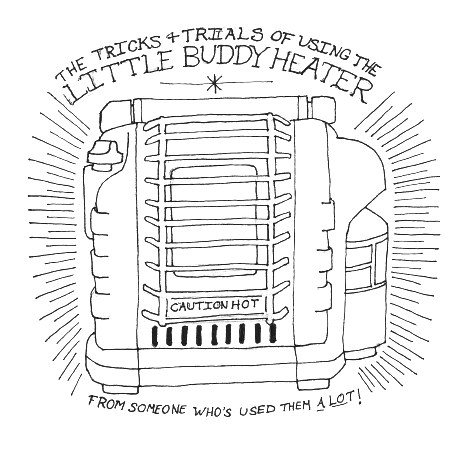
An ink drawing of The Little Buddy Heater with the text: “The Tricks + Trials of Using the Little Buddy Heater”
“From Someone Who’s Used Them a Lot!”
The first time I slept in North Carolina in November, it definitely got down into the teens at night. I started working festivals because I wanted to earn money while primitive camping, somewhat because I was disgusted with consumer culture and infatuated with old-world crafting. Thus, I was living in an 8”x8” tent, and trying to buy as little as possible, especially appliances. I didn't have a sleeping bag, only a pile of blankets. Someone had suggested getting a buddy heater, but also tried to warn me, “don't sleep with it on.” According to them, the previous year, someone they knew had fallen asleep with one on too close to their feet, and woke up in the middle of the night with their blanket on fire. I laughed. I would never need to worry about that. I was going to be the minimalist outdoor queen, surviving off of my superior survival skills. I dismissed the whole idea as, "cheating."
I am a cheater now. I carry around a heater in my car to use while camping, and use it throughout the fall and winter. I have gone through weeks of cold weather, and the value having a heater around, whether to dry your hair after a needed shower, warm your fingers after cleaning dishes, or to quickly warm your tent before you wind down for bed, can't be understated.
13F is the coldest temperature I've spent in a tent alone. It was a still October night in Carolina, not a leaf twitching as I turned on my heater to change clothes; I knew from experience that wind could whip the warmth out of your tent, so I was thankful for that. I was traveling lighter than usual, just enough stuff to get by in an 8x8 tent, which I had stored in a friend's car to get there. Even so, I still made sure I brought along my Buddy Heater. I turned it on that night to warm up the space, and allow me a few moments of warmth before I went to bed. I had an inflatable foam mat between me and the ground, a zero degree sleeping bag, and a blanket. I used my down jacket to cover me further on the outside, and put on some alpaca gloves and a crocheted beanie. After about fifteen minutes, I turned off the heater to go to sleep, I was not going to be the guy that set themselves on fire that they told stories about. I settled down into my bedding and stared up at the ceiling of my tent. I had slipped a square of scrap canvas in-between the rain-fly and the main tent body. This covered the screen ventilation and kept some heat in. Even with this precaution, I could still feel the cold seeping through the tent walls, grazing my cheeks, even in my sleeping bag through the zippers. I was just warm enough to not feel in danger, but not warm enough to be comfortable. This was as good as it was going to get.
The Little Buddy heater will keep you warm, either to save you from the consequences of your questionable life choices, or help you when the power is out after an emergency. The heater, when working properly and used on the two marked settings, mixes air and propane in a particular mixture so little to no carbon monoxide is produced, which allows it to be used inside of tents and other enclosed spaces. It runs off of the little green cans of Coleman propane, which run a number of Coleman products.
I got on the road with environmentalism in mind, so my biggest complaint is that the green cans aren't easily recyclable. A nice guy on the phone at one of the local landfills said they don't take them unless they have a hole in them that you can see through. Coleman used to have a "green key" system where you could use a specially designed plastic bit to release any pressure, thus marking them as “safe,” but the program was discontinued. (See more about how to recycle small Coleman propane tanks here: https://goneoutdoors.com/recycle-coleman-propane-fuel-canisters-7382593.html)
You can, however, hook up a bigger tank. Propane in a bigger tank is dirtier than the Coleman fuel, it isn't designed for this sort of use. If you hook up a big tank to a buddy heater with a hose, after a few months of continuous use, it will eventually sputter out and die. There is a filter you can buy to connect to it to extend the life of the heater, (Buddy Heater Filter, part #F273699, which you can search for online) and while I haven't tried it myself, I have had several friends use it with success. I can't say I haven't heard people who've had problems using big tanks, though, including small fires. Know what you’re doing.
Even using the small tanks exclusively, I have encountered a few little quirks. One night, I was alone in my tent, and had had the heater sitting on high. I went to turn it off, to find that the knob actually became stuck on the "On" position. I had nothing else available to me (no fire extinguisher at the time), so in a panic, I rocked it back and forth a bit in exasperation. The heater has an emergency feature where it shuts off if knocked over, and to my immediate relief, it shut down. After a spell, I continued to use it even with this flaw for a few more years before I decided to upgrade to a new heater for my safety.
The emergency shutoff is a nice feature if you have other critters living with you; I have learned the hard way that animals do not understand fire. Back when I was traveling with a cat, I had the heater on one evening and I was sitting in front of it, getting the chill out of my hands. My cat came up to me from behind the heater. I watched him closely, ready to scoop him up if he got too close. To my horror, upon feeling the warmth coming from the heater, his first instinct was to rub up against it. Before I could react, I saw him flinch and the whiskers on the side of his face singe and whither. I grabbed him to prevent further injury, but he wasn't quite done testing his limits.
A little later on, during another round of heating, I noticed him moving to sit in front of it. He was in front, between me and the heater. He was close to it, but still far enough away that I thought he might be okay. I wanted to give him the freedom to regulate his own body temperature; surely, I thought, he would move if it was too hot. It turns out that this was not a good call. As I watched, I noticed a faint bit of smoke starting to roll up from his fur. I grabbed him and scooped him into my lap, trying in vain to explain the danger that he was just in. We then knew we had to watch the heater carefully when he was around.
Despite its flaws, the Buddy heater is a lifesaver. It requires some caution, but any open flame is going to require such. I'll be using it throughout the rest of this winter. Stay warm out there, friends.